The Open Invitation Myth: What a Local Invitation Leaves Unsaid
A clear local invitation explains who can come, what will happen, and how to join, so newcomers can decide whether the group feels accessible.
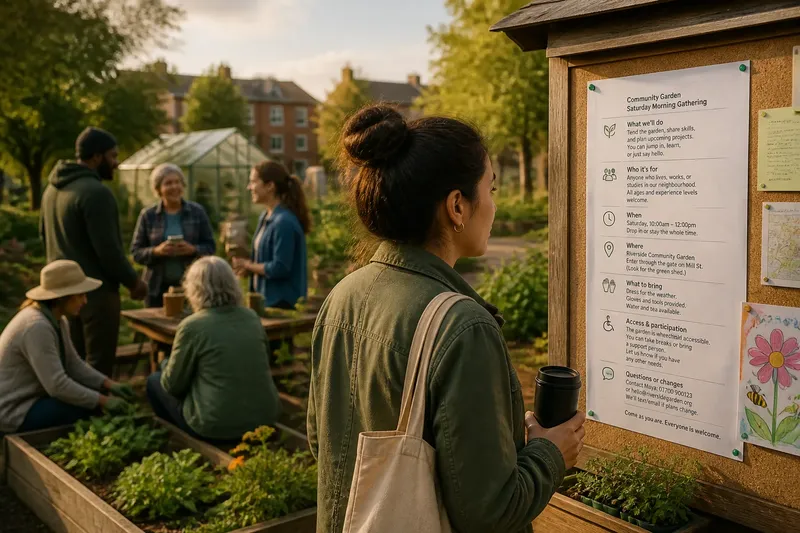
The most common mistake in inviting someone to a local group is assuming that “Everyone is welcome” answers the questions a newcomer has. It may sound generous, but without details about the activity, arrival, cost, or social expectations, the invitation leaves the person to guess—and guessing can be enough to keep them away. A useful invitation does more than express goodwill: it makes the next choice legible.
This is the open invitation myth: the belief that removing an explicit barrier automatically makes participation accessible. In practice, people often need to know what they are agreeing to before they can decide. The aim is not to script every moment or promise that everyone will feel at home. It is to replace avoidable uncertainty with concrete, honest information.
Why does “everyone is welcome” still feel hard to answer?
General warmth tells a person how the group hopes to be seen. It does not tell them what they will encounter. “Come along to the community garden” could mean an organized work session, an informal conversation, a planning meeting, or several of these at once. Someone deciding whether to attend may be unsure which clothes to wear, whether they need to know gardening, or whether they can simply watch.
Vague invitations also put the work of clarification on the newcomer. They must identify what is missing, ask someone they may not know, and risk seeming demanding. People who are new to the area, unfamiliar with the group’s customs, or unsure whether their needs will be accommodated may be especially reluctant to make that first inquiry.
The answer is not to make every invitation exhaustive. It is to identify the few facts that shape a person’s decision, then provide a simple way to ask about anything else. A concise invitation can be open and specific at the same time.
What will happen after someone arrives?
A meeting title is not a description of the experience. “Neighborhood clean-up” names a purpose, but leaves open whether people will pick up litter, sort donated supplies, walk a route, or plan future events. It also says nothing about how a new arrival joins in.
Describe the activity in ordinary terms. Say what people will do, whether the activity involves moving between places, and whether someone can attend without taking on a task right away. If the plan might change, say what is settled and what is still flexible. This helps people imagine the event without implying that every detail is fixed.
For example, imagine a block association posting, “Join us Saturday to talk about the vacant lot.” A clearer version might say, “We’ll meet at the library’s side entrance, look over a sketch of the lot, and collect ideas for possible uses. You can listen without speaking, and no planning experience is needed.” The expected result is not that every reader will attend; it is that readers can judge what the gathering involves and whether it suits them.
Who is the invitation actually for?
Words such as “neighbors,” “families,” or “volunteers” can sound self-explanatory to regular participants but mean different things to different readers. A person may wonder whether they need to live on a particular street, bring children, already belong to the organization, or commit to a recurring role.
State eligibility plainly when it matters. If an activity is open to anyone in the area, say so. If a group has a membership requirement or needs people to register, name that before the invitation’s closing line. Avoid implying that attendance is open to all when a practical limit applies; instead, explain the limit and offer a contact route for questions.
Be equally clear about whether attendance means joining the group. A public event, a trial visit, and a formal membership meeting are different invitations. Naming which one you mean prevents a visitor from having to infer the group’s expectations from how established members behave.
What practical details should appear up front?
People may be ready to join the activity but unable to assess whether they can get there or participate comfortably. A venue name alone may not identify the entrance. “Bring what you need” transfers planning to the reader without explaining what is useful. When details are known, include them rather than expecting newcomers to ask.
- Time and duration: Give the start time and an estimate of when the activity ends, or say if people can leave early.
- Location and arrival: Name the building or meeting point, identify the entrance if it is not obvious, and explain whom to look for.
- Cost and supplies: Say whether there is a fee and whether tools, materials, or refreshments are provided.
- Participation options: Mention whether someone can observe, come late, bring a support person, or take a break, if those options are available.
- Access information: Share known details about entrances, seating, restrooms, noise, or the route through the venue, and give a way to ask about other needs.
- Contact and changes: Name a person or reliable channel for questions, and explain how weather or a venue change will be communicated.
Details should be accurate rather than aspirational. Where a venue feature or activity requirement depends on a label, manufacturer instructions, or local rules, check the applicable information before describing it. If something is unknown, say that plainly and identify who can help clarify it.
How can the invitation explain social expectations?
Practical logistics do not cover every uncertainty. A newcomer may also wonder whether they must introduce themselves, speak in a group, bring a contribution, or already know someone. Groups do not need to erase their character to make this clearer; they can simply explain the customs that affect a visitor’s choice.
Give examples of what participation can look like. “People usually introduce themselves at the start; passing is fine” is more informative than “Come as you are.” If conversation is central, say so. If the activity is mostly quiet or hands-on, describe that instead. Avoid describing a group as “friendly” as a substitute for explaining what people do together.
It is also useful to state what is not expected. A one-time visitor may not need to volunteer for future events, make a donation, or share personal information. Mentioning these boundaries can make the invitation feel more trustworthy, provided they reflect the group’s actual practice.
What if readers still have questions?
How much detail belongs in a short invitation?
Put the decision-making essentials first: activity, audience, place, time, and how to ask a question. Add one or two details likely to affect participation, then link or point to a fuller description if one exists.
Should a group list every access feature?
Share what is known and relevant, such as the entrance, seating, or restroom arrangement. Do not claim a space is accessible as a blanket assurance; invite a person to ask about a specific need and route the question to someone able to answer.
What if the plan is still being decided?
Separate confirmed details from open questions. For instance, say where the group will meet and that participants will choose between two proposed activities after arriving.
How can someone respond without committing?
Offer a low-pressure contact method and say whether an advance reply is needed. A person should be able to ask about the event without being treated as though they have already signed up.
What should a group change when invitations stay vague?
Start with the invitation itself, not with assumptions about why people did or did not come. Read it as someone who does not know the venue, members, or routine. Mark every phrase that relies on insider knowledge: “usual entrance,” “bring the standard kit,” or “we’ll do the normal round.” Replace each with a plain explanation or remove it.
Then ask a person outside the regular group to identify what they would still need to know before deciding. This is not a request for them to represent every newcomer; it is a way to notice missing context. If the same question keeps arising, add its answer to future invitations rather than making each person ask privately.
There is little value in polishing slogans, adding elaborate welcome language, or designing a long form when the event’s basic details remain unclear. A short, direct description does more useful work than a string of reassuring adjectives.
How can openness remain honest?
An invitation should not promise an experience the group cannot control. “You will feel at home” speaks for another person’s feelings. “A member will meet you by the front desk and explain the activity” describes an action the group can plan to take. This distinction lets a group communicate care without presenting belonging as automatic.
Likewise, avoid treating one announcement as the whole access plan. Someone may still need to clarify a route, request a quieter place, or ask whether a child can come. A named contact and a courteous answer matter because the invitation opens a conversation, not because it can anticipate every circumstance.
For groups refining their local invitations, the main search phrase—how to make a local group invitation clear—points to a practical standard: tell people what they will do, what they need to know, and how to ask before they arrive. Clear details do not make a group universally suitable, and they do not settle every access question. They do give each reader a fairer basis for deciding whether to take the next step.