The First Visit: Find One Clear Point of Entry
A clear point of entry helps you make a first visit to a local group on your own terms, with a concrete way to join, observe, or ask what comes next.
The most common first-visit mistake is treating a local group as a room you must enter and immediately fit into. That can make a simple outing feel like an audition. Instead, look for one small contribution that gives you a reason to be there and lets you see how the group works.
What can you contribute without taking on too much?
A first visit need not be a test of whether you belong. It can be a chance to learn what people actually do together, what kinds of help are welcome, and whether the group’s rhythm suits you. You can participate by listening, asking a practical question, or taking on a modest task.
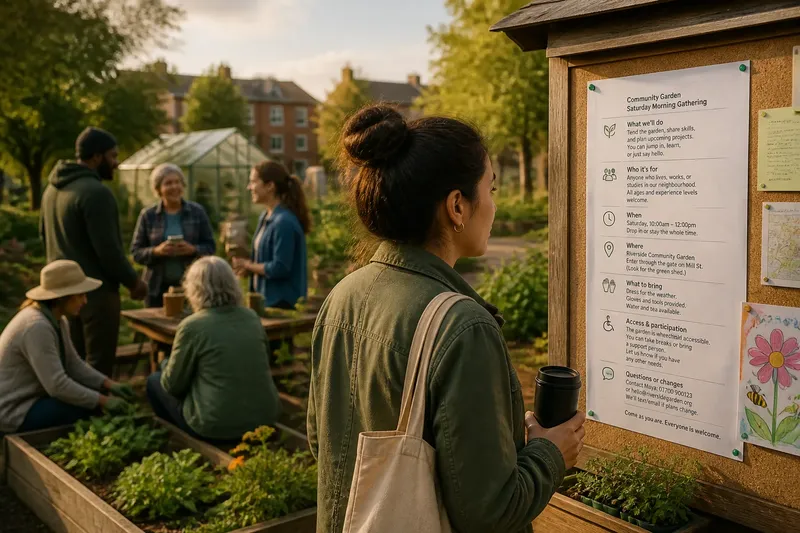
Look at the group’s public notice, community calendar, email, or social page for an activity that has a clear beginning. A garden group might be sorting seed packets; a repair circle might be organizing donated tools; a neighborhood association might be setting out chairs. Concrete tasks make it easier to understand how to join than a broad invitation to “get involved.”
It is not worth researching every past project or planning a polished introduction. Spend that effort finding out what a newcomer can do, watch, or ask about during the gathering.
How do you find a useful role for a first visit?
Start with what the group says it needs, then ask about the smallest practical way to take part. You might write: “I’m interested in attending the Saturday garden gathering. Is there a simple task newcomers can join, or is it better to observe first?” This gives the organizer room to suggest a role or explain that the activity is not suited to drop-in participation.
Notice the difference between a task and a commitment. Carrying materials to a table or sorting supplies can help you learn the group’s routine without signing up to lead an event. If a task requires training, tools, or advance approval, ask before assuming you can begin.
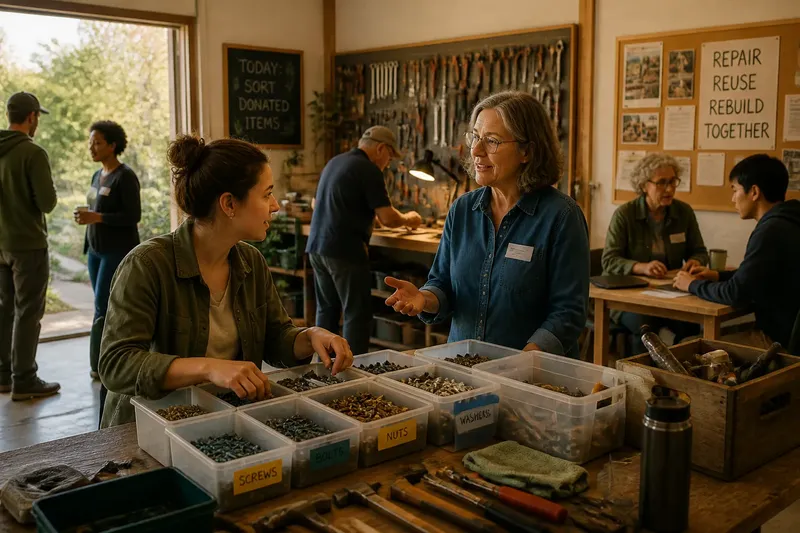
Say you see a notice for a neighborhood repair circle that mentions sorting donated items. You message the contact and learn that newcomers can help identify loose screws and place them in labeled trays, while repairs themselves require an experienced volunteer. You arrive, ask for the sorting task, and learn how the group organizes its supplies; the result is a clear way to participate without taking on work you are not prepared to do.
What should you check before choosing a task?
A small role is only useful if it is appropriate for the activity and for you. Use this short check to decide whether to join, ask for an adjustment, or simply observe:
- Task instructions: If the group explains a simple task and what finished work looks like, then try it; if instructions are unclear, ask for a demonstration or choose to observe.
- Tools or materials: If the organizer says supplies are provided, then arrive without extra equipment; if a specific item is required, confirm whether you can borrow it or take a different role.
- Experience: If the task is described as open to newcomers, then ask where to start; if it requires training or specialist knowledge, request an introductory task or watch instead.
- Physical demands: If the task fits what you are comfortable doing, then accept it; if lifting, standing, or movement is a concern, ask about a seated or lighter alternative.
- Time commitment: If the task has a clear stopping point, then decide whether that fits your visit; if it could expand into an ongoing responsibility, ask what you are agreeing to before saying yes.
- Group expectations: If visitors can participate without registering, then follow the posted arrival guidance; if the activity needs advance sign-up, contact the organizer before setting out.
These checks are not a demand to disclose personal details. They are ways to make an informed choice and avoid accepting a role whose expectations are unclear.
How can you join in while keeping your choice open?
When you arrive, introduce yourself briefly and name the task or question that brought you. “I’m new here, and I asked about sorting the donated tools” is enough. If you would rather watch first, say so plainly and ask where to stand or sit without getting in the way.
Pay attention to how the group responds. A member might show you a task, explain who makes decisions, or suggest that you observe for now. That response tells you something about the group’s way of including newcomers; it does not require you to accept a larger role.
If the task changes or begins to involve a commitment you did not expect, pause and ask what the group needs. You can decline, request a smaller role, or leave at an agreed stopping point. A clear boundary often makes participation easier to understand for everyone.
What questions help you choose how to participate?
Can you attend without taking a role?
Often, but check the group’s invitation or ask the organizer if the activity is designed for visitors to observe. If participation depends on registration or a particular task, learn that before arriving.
What if you have no relevant experience?
Ask whether there is a beginner-friendly task or whether watching would be more useful. Do not claim experience you do not have, especially where a task involves tools, equipment, or other people’s property.
How do you avoid being assigned an ongoing responsibility?
Ask whether a task is for that gathering or part of a recurring role before agreeing. If the group needs continuing help and you are unsure, say you can consider it rather than committing on the spot.
What if the suggested task does not suit you?
Thank the person and ask whether there is another way to take part, such as observing or helping with a different task. If no suitable option is available, you can leave politely and ask about another gathering.
What can a first visit tell you about the group?
Notice whether people explain tasks clearly, make room for questions, and respect a newcomer’s choice to observe or decline. Also notice the practical structure: who gives direction, how people share materials, and whether the activity matches its description.
You do not need to judge the whole group from one gathering. If the role was unclear, ask one follow-up question before deciding. If the task felt manageable and the group’s approach suited you, you might return or offer a little more help next time. The point of a first visit is to learn what participation could look like for you, not to settle every future decision.
A first visit to a local group becomes easier to assess when you can name the task you tried, the support you received, and what you would choose differently next time. Those details give you a more useful basis for deciding whether to return than the pressure to make an immediate judgment about belonging.